


TeamFun.events brings people together through smart games that inspire connection and celebrate achievements through shared experiences.
.svg)

Boosting employee morale isn't about throwing a few perks at your team and hoping for the best. It’s about listening—really listening—to what they’re saying, recognising their work, and building a culture where people feel safe, valued, and connected.
It means moving past the occasional Friday drinks and creating systems that genuinely support your people. The first step? Learning to spot the problem before it spirals.
Before you can fix low morale, you have to see it for what it is. It rarely announces itself with a formal complaint or a dramatic walkout. Instead, it’s a quiet undercurrent, a subtle shift in the office atmosphere that’s easy to miss if you’re not paying attention.
As a manager in Sydney, getting on top of this means looking beyond the obvious metrics like sick days or staff turnover. The real work is in learning to read the room and spot the less obvious red flags that signal a deeper issue with team engagement.
So, what should you be looking for? One of the first things to disappear is what we call discretionary effort. This is all the value-add stuff your team does simply because they want to—like staying a few minutes late to help a colleague, brainstorming a better way to do things on their commute, or just taking pride in a shared project. When that voluntary effort dries up and people start doing just enough to get by, you know there’s a problem.
Another tell-tale sign is a change in the break room chatter. Pay attention to the conversations happening around the office. When you hear less "what if we tried this?" and more cynical "what's the point?" comments, it's a clear sign that collective optimism is fading. That kind of negativity can spread quickly.
To help you get a clearer picture of what to look for, here’s a quick-reference guide to the common indicators.
Indicator TypeSpecific Signs to Watch ForBehaviouralA drop in discretionary effort—people stick strictly to their job descriptions. Less informal collaboration and social interaction. An increase in gossip or cynical chatter.EmotionalGeneral apathy or a lack of enthusiasm, even for big wins. Increased irritability, defensiveness, or a new resistance to feedback. A visible drop in energy and passion for the work.ProductivityDeadlines are consistently missed. The quality of work declines. Less initiative is shown for new projects or problem-solving.
Keep this table handy. When you start noticing a pattern of these signs appearing together, it’s time to dig deeper instead of assuming it's just a bad week.
This simple flow chart gives you a framework for thinking about this. First, you spot the signs, then you get to the root of the symptoms, and only then can you apply the right fix.
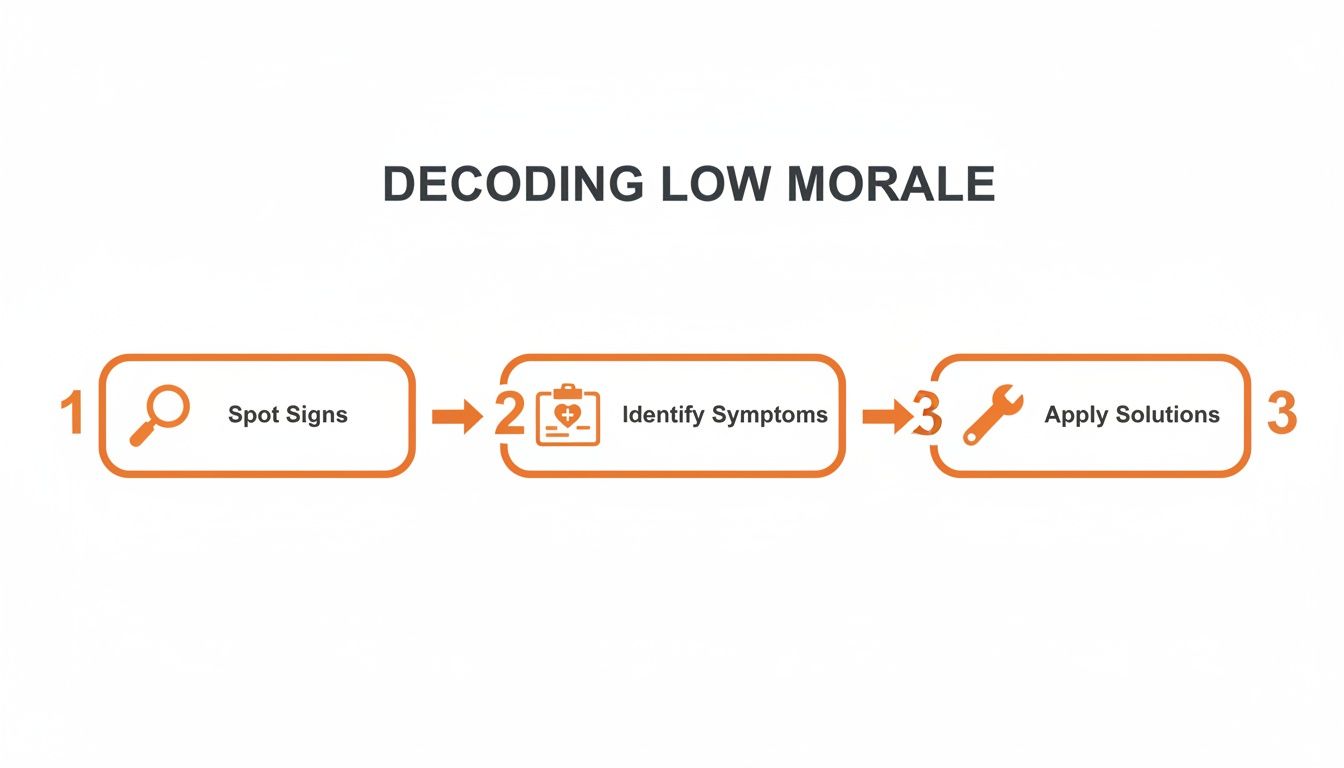
This really drives home that boosting morale isn’t a guessing game. The best solutions are always the ones that directly target the specific issues you've uncovered.
You can't talk about morale without talking about its arch-nemesis: burnout. It’s more than just feeling tired; it’s a state of chronic exhaustion that completely saps a person's motivation and drive. Recent data from Australian workplaces shows just how serious this has become.
A staggering 46% of Australian employees reported experiencing burnout in 2025, a figure that climbed to 50% for those in crucial operational and middle management roles.
This isn't just a "wellbeing" issue; it’s a direct hit to your team's morale, creating a vicious cycle of exhaustion and disengagement. The good news is that targeted support can make a huge difference. As detailed in the full Leading Mentally Healthy Workplaces Survey Report, well-planned initiatives that foster connection can deliver a significant return by tackling these issues head-on.
Here are a few more organisational symptoms to keep on your radar:
Spotting these symptoms isn't about blaming your team. Think of it as vital feedback on the health of your workplace culture. Once you have an accurate diagnosis, you can start implementing the targeted, strategic solutions we'll cover next.
If you're wondering how to boost morale in your workplace, start with two simple words: "thank you." It sounds almost too easy, but genuine appreciation is one of the most powerful—and most underused—tools a leader has. This isn’t a soft skill or a nice-to-have; it’s a core driver of performance and loyalty.

The data reveals a stark "appreciation drought" here in Australia. In a 2025 forecast, only 23% of Australian employees reported feeling genuinely appreciated at work. That’s a shocking 15-point drop from the previous year. For frontline and deskless workers, the number plummets to a dismal 14-16%.
These figures expose a huge disconnect between the effort people are putting in and the acknowledgement they receive. This directly erodes morale, especially for women, where just 19% feel valued. As a Reward Gateway report highlights, there's a clear line connecting recognition, psychological safety, and motivation, and you can dig into the full impact of the workplace engagement index.pdf?hsLang=en) to see the bigger picture.
To fix this, recognition can't just be an afterthought. It has to be woven into the very fabric of your company culture—frequent, specific, and visible to everyone.
Annual awards and year-end bonuses are fine, but they don't fuel day-to-day motivation. Real morale is built on the small, consistent moments of acknowledgement that make people feel seen right now. The goal is to create a workplace where showing appreciation is a reflex, not a scheduled event.
Start with your own behaviour. Don't wait for the weekly team huddle to give praise. Catch someone in the act of doing great work and give them immediate, specific feedback. A simple, "Hey Alex, the way you handled that client call was brilliant—you were so patient and found the perfect solution," is far more effective than a generic "good job" days later.
A culture of recognition isn't about grand gestures. It's about creating a continuous stream of positive reinforcement that tells your team, "Your work matters, and we see you."
This simple habit also builds psychological safety. When people feel their contributions are valued, they’re more willing to share ideas, ask questions, and take smart risks.
Beyond your own efforts, you can build simple systems that encourage everyone—not just managers—to give praise. The key is to make it easy and authentic, not another corporate box-ticking exercise.
Here are a few ideas you can roll out this week:
#wins or #kudos. Encourage staff to publicly thank colleagues who helped them out. This shines a light on the cross-functional collaboration that often goes unnoticed.For instance, a Sydney tech company I worked with realised their developers felt completely disconnected from the sales team's victories. They organised a casual quiz night to celebrate a tough quarter, mixing up the teams. That one night of friendly competition did more for mutual respect than a dozen formal meetings ever could. For more on this, see our tips on the evolution of the corporate quiz night in Sydney.
Finally, remember that recognition isn't one-size-fits-all. Some people thrive on public praise, while others cringe at it and would much prefer a private note of thanks. Pay attention to what actually resonates with your people.
The most effective recognition is always authentic and tied to your company's values. Whether it’s a handwritten card, a small gift voucher for a local Sydney coffee shop, or an extra day off after a gruelling project, the best "thank you" is the one that feels personal and sincere.
You can't have high morale without a foundation of trust. It’s that simple. Your team won't innovate, collaborate effectively, or perform at their best if they’re constantly worried about speaking up, admitting a mistake, or challenging the status quo. Think of psychological safety as the bedrock of a great company culture, and building it starts right at the top.

When this safety is missing, the costs—both human and financial—are enormous. The latest figures show mental health claims in Australia shot up by 14.7% in 2025, and now account for 12% of all serious claims. The time off required for these claims is almost five times longer than for physical injuries, marking a jaw-dropping 161% increase over the past decade. With organisational support flagging, it’s painfully clear that creating a safe environment isn't just a 'nice-to-have' anymore. Dig into the full Key Work Health and Safety Statistics for Australia if you want to grasp the full scale of the issue.
Cultivating a psychologically safe workplace is one of the most powerful things you can do to boost employee morale, and it's something you can start working on today.
As a leader, you set the tone. If you want your team to feel safe enough to be open and honest, you have to go first. This means getting comfortable with admitting you don't have all the answers, owning up to your own mistakes, and just showing your human side.
For instance, you could kick off a new project by saying something like, "This is a new challenge for all of us, and I'm still working through the best approach. I'll be relying on everyone's input and ideas to get this right." That one sentence completely changes the dynamic from a top-down directive to a shared mission.
This isn't about oversharing or complaining. It's about showing that it's okay to be imperfect. When a leader openly talks about a misstep and what they learned, they give their team permission to take smart risks without fearing the blame game.
Psychological safety isn’t about being nice all the time. It’s about creating an environment where people feel secure enough to engage in robust, candid debate that drives the business forward.
When your team sees that making a mistake is part of the process, not a career-ender, you'll see их creativity and engagement skyrocket. This shift in leadership behaviour is a direct investment in your team’s morale and resilience.
We all know feedback is crucial for growth, but so many feedback sessions turn into nerve-wracking critiques that just make people shut down. The secret is to frame feedback around shared goals and future improvements, rather than picking apart past failures. A truly safe feedback culture is built on a few core principles.
By shifting feedback from a dreaded critique to a collaborative process for success, you remove the fear. You create a space where everyone is genuinely committed to helping each other get better—and that is a cornerstone of any high-morale workplace.
Okay, let's get practical. We’ve all been dragged to that one team-building event that felt more like a chore than a celebration. You know the one—forced fun that left everyone cringing and checking the clock. The secret to designing events that genuinely lift morale isn't about finding a zany activity; it's about focusing on the outcome you want to create.

A well-planned event can be a powerful tool in your arsenal. It’s a chance to reinforce your company culture, celebrate genuine wins, and build the human connections that give work meaning. But it only works if it’s done with real intention.
Before you even glance at a venue or catering menu, stop and ask one crucial question: "What do we want to be different after this event?" Your answer to this will shape every single decision. A vague goal like "improve morale" is simply too broad to be useful. You need to get specific.
Maybe your objective is to:
See the difference? The goal drives the activity, not the other way around. A fast-paced, competitive game is fantastic for an energy boost, while a collaborative workshop is a much better fit for breaking down departmental walls.
Once your goal is crystal clear, you can start exploring activities that actually line up with it. There’s no such thing as a one-size-fits-all solution here. The “best” event is one that feels authentic to your team’s unique culture and personality. A highly analytical engineering team probably won't get much out of a mandatory improv class, just as a boisterous sales team might find a quiet pottery workshop a bit draining.
Think about this real-world scenario: a Sydney-based finance company was battling low morale after a major restructure. Leadership’s first idea was a fancy dinner, but after asking for feedback, they realised employees were just exhausted and wanted to relax.
Instead, they organised a low-key, professionally hosted trivia night. It was competitive without being physically demanding, encouraged people from different departments to form teams, and let everyone unwind without the pressure of forced networking. It was a massive success simply because it met the team where they were at.
The most impactful team-building events aren't the most expensive or elaborate. They're the ones that show you've listened to your team's needs and chosen an activity that respects their time and energy.
When planning your next get-together, don't just fall back on what you did last year. A simple poll with a few curated options can make a world of difference. Involving your team in the decision boosts buy-in and makes it far more likely the event will hit the mark.
In today's workplace, inclusivity isn't a nice-to-have; it's non-negotiable. If you have remote or hybrid staff, planning an event that only works for those in the Sydney office is a guaranteed way to crush morale, not build it. Real connection happens when everyone feels equally included.
Here’s how you can design events that are truly hybrid-friendly:
Thinking about your hybrid team from the very start is what matters. For Sydney managers needing some inspiration, it’s worth checking out the different types of fun and engaging activities designed specifically to bridge that physical divide. A great place to start is by exploring some of the best team-building activities available in the Sydney CBD that offer excellent hybrid options.
By being thoughtful and intentional, you can move beyond those cringe-worthy exercises and create shared experiences that genuinely strengthen bonds, celebrate success, and build a more resilient, high-morale team.
We’ve all seen it happen. You pull off a brilliant team event, and the energy in the office is electric. But what about the following Monday? All too often, that buzz disappears, and you’re left with a kind of post-party hangover. The morale spike vanishes, and you’re right back where you started.
It's a common mistake to treat morale like a project with a neat start and end date. A single event, no matter how fantastic, is just a sugar rush. Lasting change comes from weaving morale-boosting habits into the daily, weekly, and monthly rhythm of your workplace.
This is the real work: moving beyond one-off gestures to a sustained strategy. It’s about creating a steady drumbeat of positive moments that your team can actually rely on, transforming good feelings into a genuinely great culture.
The secret to making morale stick is to layer your efforts. I always compare it to a fitness plan – you wouldn't hit the gym once and expect to be fit for life. It’s the same with culture. You need a mix of small, consistent exercises and bigger, more intensive workouts to build a strong and resilient team.
This means pairing those major events with smaller, regular rituals that reinforce connection and appreciation. The best part? They don’t have to be expensive or elaborate. Their power comes from consistency.
When you establish these rituals, you build positive anticipation. People know there are regular chances to connect, celebrate, and be recognised. That’s what sustains morale far more effectively than a single annual party, and it’s a crucial part of boosting employee morale in the workplace for the long haul.
Here are a few small but mighty habits I’ve seen work wonders:
A sustained strategy isn't about more work; it’s about being more intentional. It's the difference between throwing a party and building a community.
This approach shows you trust your leaders, giving them the autonomy to reward their teams in ways that feel timely and meaningful. It’s how you empower them to build morale from the ground up.
To avoid the dreaded morale crash, you need a plan that layers those quick wins with more significant initiatives. This creates a continuous upward trend, not a rollercoaster of highs and lows. A forward-thinking calendar helps you stay proactive instead of just reacting to problems.
Think of the calendar below as a sample framework. You'll see how each month combines a small, easy-to-implement "quick win" with a more substantial, planned "major initiative." This ensures there’s always something positive on the horizon for your team to look forward to.
MonthKey FocusQuick Win ActivityMajor Initiative1FoundationLaunch a weekly "Wins of the Week" email or Slack channel.Host a kick-off event to set the tone for the year (e.g., a catered lunch).2ConnectionImplement 'coffee roulette,' pairing random staff for a chat.Run a cross-departmental team-building game to break down silos.3RecognitionEmpower team leads with a small budget for spontaneous rewards.Hold a mid-quarter celebration to recognise progress toward goals.4WellbeingOrganise a "walk and talk" meeting day to get people moving.Bring in an expert for a workshop on stress management or resilience.5Fun & EnergyIntroduce a fun monthly competition (e.g., desk decorating).Plan a major offsite event like a strategic games day or a quiz night.6ReflectionRun a pulse survey to gather feedback on what's working.Host a half-year "look back and look forward" session with team awards.
This calendar isn't a rigid script; it's a strategic guide to get you started. By consistently weaving these small and large efforts together, you stop just temporarily boosting spirits and start fundamentally changing the employee experience. That's how you build a workplace where high morale is simply the norm, not the exception.
Even the best-laid plans hit a few snags. As you start putting these ideas into practice, you're bound to run into some of the same challenges that Sydney managers bring up with me time and time again. Let’s tackle those tricky, real-world questions head-on.
This is the question I hear most often, and my answer usually comes as a relief: the most powerful morale boosters are almost always free. You don't need a huge budget to make a difference. What you need is genuine, consistent effort.
Forget expensive perks for a moment and focus on high-impact, low-cost actions. Thoughtful public and private recognition costs you nothing but a few moments of your time, yet it pays huge dividends by making people feel seen and valued. Even something as small as blocking out the first five minutes of a meeting for a non-work chat can completely change the tone, signalling that you care about your team as people.
Your budget doesn't determine your impact. Your authenticity and consistency do. Meaningful recognition, psychological safety, and leaders being a bit more human are free resources with an almost infinite return on investment.
Here are a few ideas you can roll out this week without getting finance involved:
By building on these foundational elements, you can foster a positive and supportive environment without spending a dollar.
Getting buy-in from senior leadership often means speaking their language, and that language is data. While you can’t put a dollar value on a smile, you can absolutely track tangible business metrics that are directly influenced by morale.
The key is to benchmark your starting point. Before you roll out any new initiatives, take a snapshot of your key data. Then, after three to six months, measure it all again. The metrics that tell the clearest story are:
Alongside these hard numbers, use short, anonymous pulse surveys to get a feel for the qualitative shifts. Ask simple questions about engagement, team connection, and whether people feel appreciated. Combining this hard and soft data gives you a powerful, well-rounded picture of the return on your investment.
First things first: don't write them off as "not a team player." Resistance to team-building is almost never about the activity itself. It’s a symptom of something deeper, usually stemming from past experiences with cringey, forced-fun events or a cynical feeling that it’s all a waste of valuable time.
The antidote is choice and involvement. Instead of planning a single mandatory event, try offering a few different options that cater to different personalities. You could propose a competitive escape room, a creative workshop, and a low-key social lunch at a local spot, and then simply let the team vote.
Honestly, involving the team in the planning is the single best way to get buy-in. When people feel they have a say in what they're doing, the activity stops feeling like a corporate mandate and starts feeling like their own. It’s a simple shift, but it can turn your biggest sceptic into your most enthusiastic participant.
Ready to design an event that your team will actually love? TeamFun Events delivers smart, high-energy experiences in Sydney that turn work into play and build genuinely stronger teams. Learn more about our unforgettable events at https://teamfun.events.